
“We can now mobilize resources and use them in accordance with the adopted budget.”
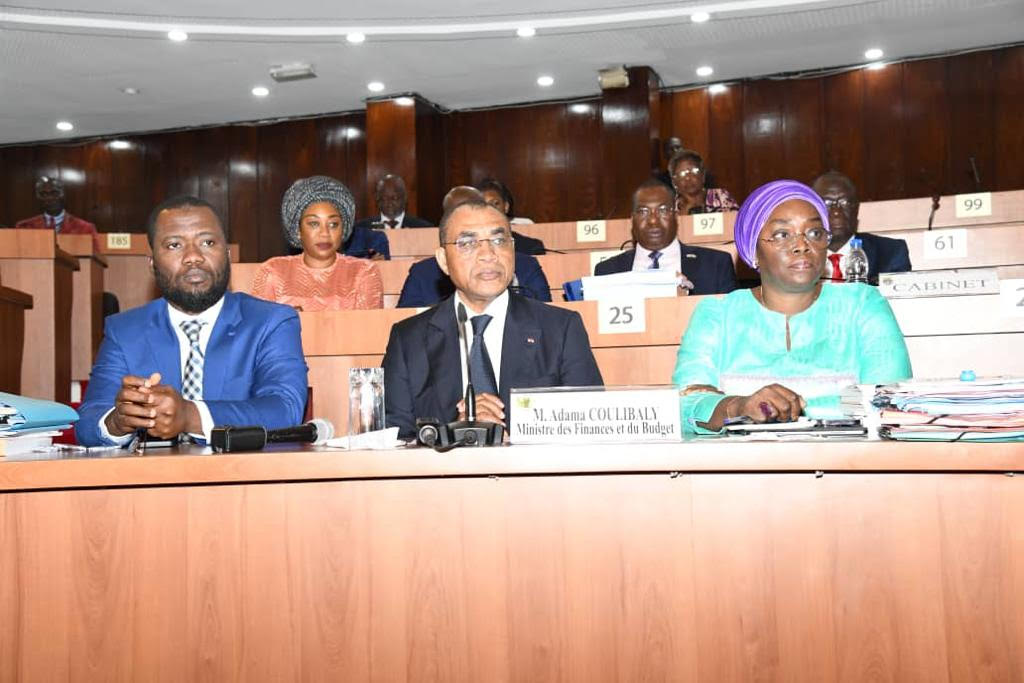
He opened the debates at the National Assembly on the 2024 Finance Bill last Tuesday, recalling in his introduction that Côte d’Ivoire’s proposed 2024 budget is balanced in revenues and expenditures at CFAF 13,720 billion, representing an increase of 17.3% compared with the budget approved in 2023. On the evening of Friday, November 10, the Minister of Economy, Finance and Budget, Adama Coulibaly, presented this budget, composed of 23 articles, and its Tax Annex before the Economic and Financial Affairs Committee (CAEF) of Parliament, after four days of intense debates marked by the appearances of the Government’s 33 ministers, who came to defend the budgets of their respective ministerial departments.
Thus, the debates ended this Saturday at around 1 a.m., with the members of the Committee granting approval to the Government’s representative, who welcomed the successful conclusion of these four days of intensive work, while highlighting the importance of the Finance Bill for the 2024 State Budget and its Tax Annex.
“I am a fulfilled man this evening because the members of Parliament have just unanimously adopted the Finance Bill for the 2024 fiscal year. (…) Tonight marks the culmination of all the work that has been done. The ministers’ budgets were adopted individually. Today was also the presentation of the Tax Annex. The Tax Annex is extremely important because it will enable the State to generate domestic resources. Today, the issue of domestic resources is important because it will allow us to rely less on external resources and borrowing. Fundamentally, in public financial management, we must first and foremost rely on our own resources, namely fiscal resources. Therefore, this evening, after the adoption of the Tax Annex, we can say that we are satisfied and that we now have the necessary authorizations not only to mobilize resources, but also to use them in accordance with the drafted and approved document,” said Minister Adama Coulibaly at the end of the proceedings.
Before reaching this final stage, and during the presentation of the explanatory statement of this Finance Bill, he also emphasized that despite external shocks, the Ivorian economy continues to consolidate its momentum. For 2024, fiscal policy will aim to preserve and strengthen the sustainability of public finances following the negative impact of external shocks caused by COVID-19 and the war in Ukraine, while supporting the structural transformation of the economy and addressing social and security needs. “It is therefore characterized by fiscal consolidation, with the gradual reduction of the deficit from 5.2% of GDP in 2023 to 4% of GDP in 2024, with a view to complying in 2025 with the community standard set at a maximum of 3% of GDP,” the Government’s representative stated.
In this regard, he continued, fiscal policy will focus on intensifying efforts to increase domestic revenue mobilization, ensuring the efficient management of the State’s operating expenses, and controlling public debt. It will also prioritize the acceleration of investments in growth-driving sectors, the strengthening of socio-economic infrastructure, the consolidation of the security framework, and increased spending aimed at reducing poverty and social disparities, particularly through the continued implementation of the Government Social Program (PSGouv) 2022–2024, with special emphasis on youth through the Government Youth Program (PJGouv) 2023–2025.
Minister Adama Coulibaly also noted that the main assumptions underpinning the 2024 budget projections include, among others, the stabilization of global economic growth in 2024 at 3%, as in 2023; the continuation of the national economy’s growth momentum, with a rate of 7% in 2024, as in 2023; and the estimated CIF prices of cocoa, coffee, and cashew nuts at CFAF 1,577.1 per kilogram, CFAF 1,176 per kilogram, and CFAF 788 per kilogram, respectively, in 2024.
“To ensure the achievement of the objectives of the 2024 budget proposal, strict compliance with budgetary discipline will be imperative, particularly within the framework of the requirements prescribed by the provisions governing public financial management under program-based budgeting,” he assured.
From the 2024 Tax Annex
Furthermore, the Minister of Finance and Budget presented the five (5) main pillars of the 2024 Tax Annex, which comprises 31 articles. These include strengthening the State’s revenue mobilization capacity (expansion of the scope of taxation on games of chance, amendments to the provisions of the General Tax Code relating to property taxation, adjustment of the scope of taxation on pleasure boats, removal of the exemption from property tax on newly acquired vacant land, etc.), measures to support businesses (adjustment of the land registration tax rate for the cancellation of conventional mortgages, removal of receipt stamp duty for small deposits made through mobile telephone operators and other actors, adjustment of provisions relating to failure to withhold certain taxes and duties at source, exemption of public water and electricity service concessionaires from the payment of fees and penalties relating to public domain management), improvement of tax compliance (conditioning eligibility for tax or customs benefits on compliance with tax and/or customs obligations, conditioning certain administrative procedures on compliance with tax and/or customs obligations), strengthening of environmental taxation, etc.
Source:
SERCOM MFB